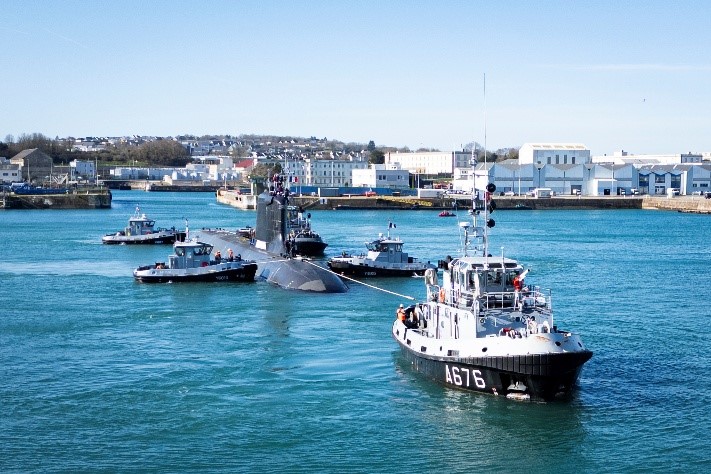

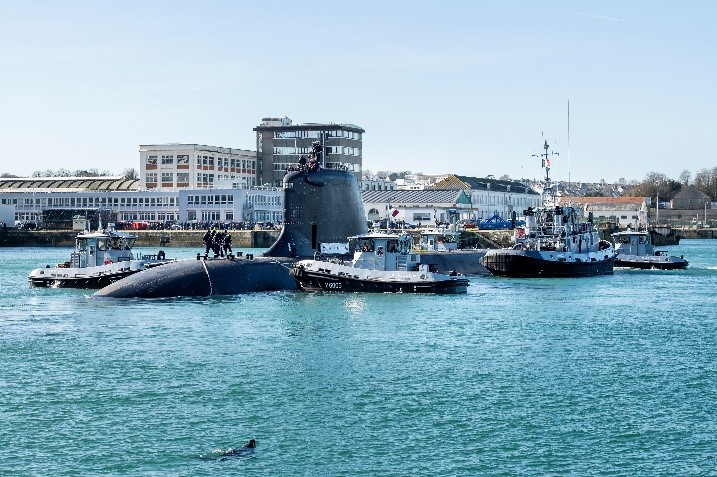
The Barracuda program, led by the Directorate General of Armaments (DGA) for the benefit of the French Navy, has reached a major milestone with the first sea trial of the Suffren De Grasse type nuclear attack submarine (SSN) on February 24, 2026.
This new stage marks the start of sea trials of the ship following the completion work and a series of successful dockside trials carried out in Cherbourg by the state and industrial teams in charge of the program.
Under the direction of the DGA, in collaboration with the Atomic Energy and Alternative Energies Commission (CEA), and in partnership with the French Navy and industry, sea trials will continue until the delivery of the SNA, scheduled for 2026.
The nuclear attack submarine De Grasse is the fourth of six Suffren-class submarines in the Barracuda program. The last two submarines ( Rubis and Casabianca ) are currently under construction at various stages of completion. Their respective deliveries are expected by 2030, in accordance with the 2024-2030 Military Programming Law.
The first sea trial of the nuclear attack submarine De Grasse , marking the start of the vessel’s sea trials, is a crucial milestone in the Barracuda program. Reaching this milestone follows the completion of construction work and a series of dockside trials conducted since the submarine’s transfer from Naval Group’s construction hall in Cherbourg to the launching dock in May 2025. After testing the onboard equipment, it was launched in the Cachin dry dock. These trials verified the proper functioning of the submarine’s various systems and equipment, its watertightness, and its propulsion. On this occasion, the nuclear reactor was also started up on December 12, 2025, during a procedure also known as “first divergence.”
After initial trials in the English Channel, the De Grasse will conduct sea trials in the Atlantic. These sea trials will be carried out under the supervision of engineers and technicians from the DGA (French Defence Procurement Agency), the CEA’s (French Alternative Energies and Atomic Energy Commission) Military Applications Division, Naval Group, and TechnicAtome, and performed by French Navy submariners. Their objective is to progressively verify all of the submarine’s technical and operational capabilities. These trials will continue until its scheduled delivery in 2026.
Throughout the sea trials phase, the vessel remains the property of Naval Group and TechnicAtome. The French Navy, the delegated operator of the military nuclear system, is in charge of the submarine’s operation and ensures operational control of the vessel. The DGA and CEA, the prime contractors for the Barracuda program, are responsible for the trials until the vessel’s acceptance and delivery to the French Navy.
The six submarines ordered by the DGA under the Barracuda program will renew by 2030 the component of nuclear attack submarines (SSN) of the French Navy, consisting of Rubis-class SSNs put into service from the 1980s onwards. The first three Barracuda SSNs, the Suffren , the Duguay-Trouin and the Tourville , were respectively admitted into active service in June 2022, April 2024 and July 2025.
Like their predecessors, the Barracuda-class nuclear attack submarines are equipped with nuclear propulsion, giving them remarkable range and stealth. They are faster, more enduring, and more versatile than previous-generation SSNs, with new capabilities for deploying special forces and striking land targets hundreds of kilometers away using naval cruise missiles. They represent a technological leap that allows France to remain among the very select group of nations operating modern and high-performance SSNs.